
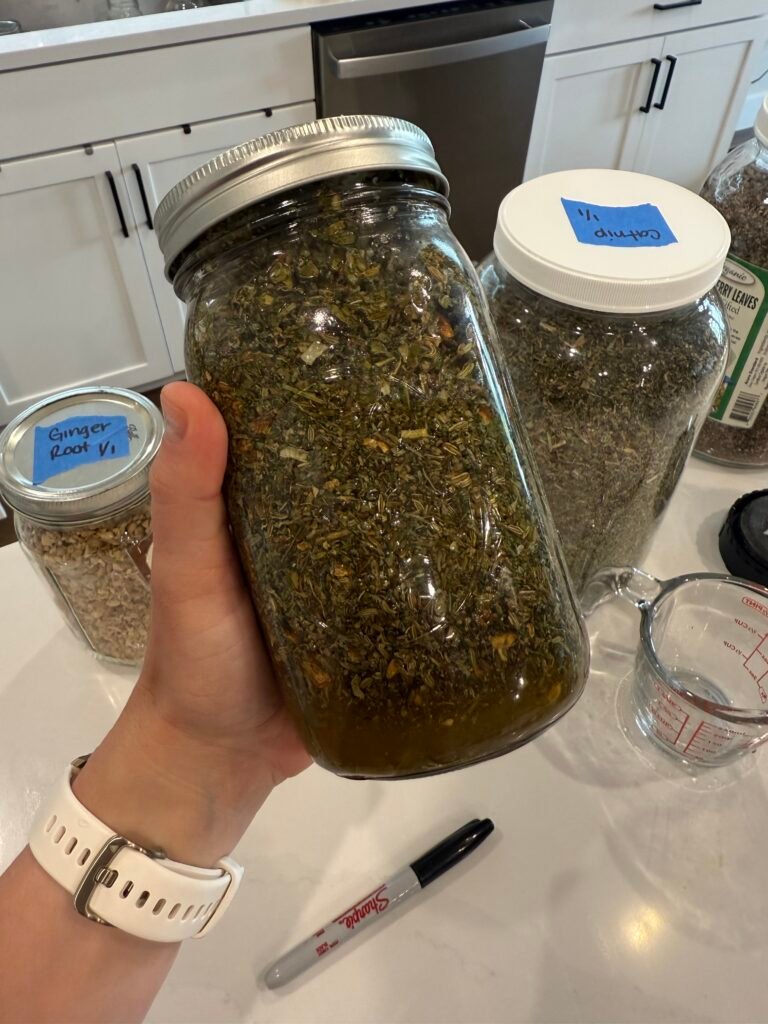
I finally did it – I made my own medicine. I officially have my first herbal tincture extracting in my cupboard. It won’t be ready for 6 weeks, but it’s on it’s way!
If you follow me on Instagram, you know I have been talking about wanting to make my own herbal medicine for some time now. I finally decided on the first tincture I wanted to make – a copycat of Earthley’s Infant Tummy Relief Tincture. I have two empty bottles, and it’s one of our must-haves in our medicine cabinet, so I figured, what better one to make than this? But the delay in execution was due to research paralysis.
Disclaimer: This content is for educational purposes only and reflects traditional folk practices. It is not intended to diagnose, treat, cure, or prevent disease. Consult your healthcare provider before trying new remedies with your children, especially if they have allergies, asthma, or other health conditions. This is not a substitute for medical care—if your child has difficulty breathing, high fever, or worsening symptoms, seek medical attention.
Affiliate Disclosure: This post may contain affiliate links. If you purchase through these links, I may earn a small commission at no extra cost to you. I only recommend products I personally use and trust. Thank you for supporting this blog!
Popping in an additional disclaimer here that I am not an herbalist. I don’t have traditional training in herbalism, and I’m just learning this as I go. I research each herb, and I am confident that they will not harm my children or me. So I feel comfortable putting together these simple tinctures as I learn.
Learn From My Mistake
There is a particular kind of frustration that comes when you try to learn something from too many sources at once.
Just the other day, I pulled out all my herbal medicine books, and I spent probably upwards of 4 hours just reading through them. Each one gave different methods for making tinctures. Each one recommended different ratios for herbs.
I. Was. Overwhelmed.
And essentially closed all the books and shelved making the tincture for that day.
The next day, I went to YouTube. I thought maybe I could find someone making a tincture similar to it and could just follow their recipe.
While I did gain some insight in which method I would use, I still couldn’t find a recipe for the 3 herbs I wanted to use.
So, I figured I’d wing it and go from there.
The Method and Menstruum
Essentially, the menstruum is the medium that you use to extract the medicinal properties from the herbs. The most common ways to extract the beneficial compounds include water, alcohol, and glycerin.
To simplify, some herbs do better with water (it’s the fastest – think making a tea!), some do better with alcohol (usually pulls out more of the beneficial properties and is a stronger tincture), and some do just fine with glycerine (though it’s often a weaker extraction, it’s fantastic for children and those avoiding alcohol, plus, it tastes sweet!).
You can use a variety of different methods when you go to extract the herbs. Most common are a cold extraction (literally put everything in a sealed jar, shake daily, and strain in 6-8 weeks), hot extraction (just how it sounds, heat it), sealed hot extraction (usually put in a sealed jar and then processed in a water bath canner for a set amount of time). There are more using fancy equipment, but I don’t have any of that. So, we are going simple here.
I chose to make a glycerine-based tincture, called a glycerite. Mainly because the tincture I was trying to copycat is a glycerite, I love it, and I know it works. And while my children will take any tincture or medicine I give them (they’re such troupers), I know they would prefer the glycerite one. Glycerin is sweet and tastes good.
Now, when you make a glycerine tincture, you need to dilute the glycerine with water in order for the glycerine to pull everything out of the herbs AND so that the tincture will be more shelf stable. It is recommended to use an organic food-grade glycerin (USP or pharmaceutical grade), I purchase mine from Azure Standard, but this one from Amazon would be my pick from there! From the books I read, most agreed that a ratio of 60% glycerine to 40% water is the safest ratio for shelf stability and not molding. Most glycerite tinctures have a shelf life of 3 years (compared to an alcohol based tincture, which has years and years and years, and some argue they never expire).
I chose a cold extraction. Mainly because it’s the easiest and low-maintenance.
Everything You Need:
Herbs
Menstruum (Extracting Liquid)
- Vegetable glycerine
- Distilled or filtered water
Equipment
- A kitchen scale – I recently got a larger one from Costco. But I’ve had this one from Amazon since 2019, and it still works great!
- A canning funnel (optional but helpful for getting herbs into the jar)
- A clean glass jar with a tight-fitting lid (mason jar works great)
- A fine mesh strainer or cheesecloth
- Small funnels for filling tincture bottles
- A dark glass dropper bottle for storing your finished tincture
- A label and marker for dating your jar
Herbs Used and Why
Catnip:
- Antispasmodic – relaxes intestinal cramping and spasms
- Carminative – relieves gas and bloating
- Nervine – calms stress and anxiety driven digestive upset (nervous stomach)
- Mild sedative – helpful when tummy trouble is keeping you up at night
- Diaphoretic – can help with fever and chills that accompany stomach bugs
- Traditionally used for colic in infants and children
Fennel:
- Carminative – one of the best herbs for gas and bloating
- Antispasmodic – eases cramping and intestinal spasms
- Stimulates digestive enzyme production – helps with sluggish digestion and fullness after eating
- Anti-nausea properties
- Mild estrogenic properties – can ease menstrual cramping that accompanies digestive upset
- Has antimicrobial properties against certain gut pathogens
Ginger Root:
- Powerful anti-nausea herb – one of the most well studied natural remedies for nausea and vomiting
- Prokinetic – speeds gastric emptying, great for that heavy/slow digestion feeling Strong anti-inflammatory – soothes irritated gut lining
- Carminative – relieves gas and bloating
- Circulatory stimulant – brings warmth and blood flow to the digestive organs Antimicrobial against several common gut pathogens
Herb Ratios
In a quart jar:
Herbs (⅓ of jar):
- Catnip: 2.5 parts / 50g
- Fennel seed: 2 parts / 44g
- Dried ginger root: 1 part / 20g
Menstruum (⅔ of jar):
- Food-grade Vegetable Glycerin USP : 380ml
- Distilled water: 255ml (*I used reverse osmosis water from my water filter. Google told me it was okay)
*I needed more Menstruum, so I added a little more glycerin and water in the same 60% glycerin and 40% water ratio.
Now We Wait
Most herbalists recommend letting the tincture extract for 4-6 weeks. I will leave mine for 6 weeks, then strain through a wire sieve, funnel, and cheesecloth. This way, I’ll be able to squeeze as much liquid as I can out of the herbs through the cheesecloth.
Bottle
It is recommended to bottle in dark or amber bottles, and store in a cool, dark place.
You’ll be thankful you have a funnel!
MAKE SURE YOU LABEL THEM!!
Remember –
I am not an herbalist; I am learning as I go. We all start somewhere and it’s okay to figure things out as you go.
I am comfortable and confident that all these herbs are essentially harmless in the doses that I will be using. So if the tincture doesn’t turn out (not really sure how it won’t?), it’s OKAY!
I can’t wait to see how it turns out and share my next concoction with you all!
WHAT SHOULD I TRY AND MAKE NEXT?!
Please leave a comment below!
p.s. I started a new series on Instagram sharing this journey! I’d love to know your thoughts!
OH, AND IF YOU DON”T WANT TO MAKE YOUR OWN.
This is the tincture we LOVEEEEEE. And what I was trying to copycat!